
 https://www.zhlabsfurniture.com/wp-content/uploads/2024/01/walk-in-fume-hood.jpg 400 400 racine https://www.zhlabsfurniture.com/wp-content/uploads/2026/08/zh-lab-logo-home-1.jpg racine2024-01-29 15:19:042026-05-09 14:59:46Promenade sous la hotte
Les laboratoires sont des installations spécialisées conçues pour la recherche scientifique, l'expérimentation et l'analyse dans divers secteurs. Ils sont classés selon leur fonction principale, leurs exigences de sécurité et les disciplines scientifiques spécifiques qu'ils servent, telles que la recherche clinique, la recherche fondamentale ou le contrôle qualité. La compréhension de ces classifications est essentielle pour garantir la sécurité des opérations, la conformité réglementaire et l'obtention de résultats de haute précision dans les activités scientifiques modernes.
Principaux enseignements
- Les laboratoires sont principalement catégorisés selon les niveaux de biosécurité (BSL-1 à BSL-4) et la spécialisation fonctionnelle.
- Les laboratoires cliniques facilitent le diagnostic des maladies, représentant plus de 701 TP3T de données pour la prise de décision médicale.
- Les laboratoires humides manipulent des produits chimiques liquides et des matières biologiques, nécessitant un mobilier robuste conforme aux normes SEFA.
- Les laboratoires à sec sont axés sur la modélisation informatique et l'analyse électronique avec des postes de travail spécialisés à protection ESD.
- Le strict respect des normes ANSI, OSHA et ISO est obligatoire pour la certification et la sécurité des laboratoires.
Qu'est-ce qu'un laboratoire ?
Un laboratoire est un environnement contrôlé, équipé d'instruments et d'outils spécialisés utilisés pour la recherche scientifique, les tests, les analyses et les expérimentations. Les laboratoires sont indispensables dans des secteurs tels que la santé, l'industrie pharmaceutique, la production industrielle, les sciences de l'environnement et les biotechnologies.
Chaque type de laboratoire est adapté à son usage prévu, avec des flux de travail, des normes de sécurité et des exigences en matière d'équipement spécifiques.
Catégorisation par fonction scientifique et objectif
Les laboratoires sont souvent définis par le type de travaux spécifiques qui y sont effectués. Ces environnements varient considérablement en termes d'équipements, d'agencement et de protocoles de sécurité. Conformément à la norme ISO 15189, les laboratoires d'analyses médicales doivent respecter des exigences techniques et de gestion spécifiques afin de garantir la qualité des analyses médicales.
1. Laboratoires cliniques et médicaux
Les laboratoires d'analyses médicales étudient des échantillons biologiques tels que le sang, l'urine et les tissus afin de contribuer au diagnostic et au traitement des patients. Ces services sont souvent organisés en sous-spécialités, notamment l'hématologie, la microbiologie et l'immunologie. Selon l'American Clinical Laboratory Association, les laboratoires d'analyses médicales traitent des milliards de tests chaque année, influençant environ 70 % des décisions médicales.
2. Laboratoires d'analyse et de recherche
Les laboratoires d'analyse s'attachent à identifier la composition chimique des substances. On les trouve couramment dans les secteurs pharmaceutique et environnemental. Les laboratoires de recherche, souvent situés dans les établissements d'enseignement supérieur, sont dédiés à l'exploration de nouvelles théories scientifiques. Selon un rapport de 2024 de la National Science Foundation (NSF), les dépenses de recherche universitaire aux États-Unis ont dépassé 104 090 milliards de dollars, ce qui souligne l'importance de ces infrastructures.

Classification par niveaux de biosécurité (BSL)
Les Centres pour le contrôle et la prévention des maladies (CDC) et les Instituts nationaux de la santé (NIH) établissent des niveaux de biosécurité afin de protéger le personnel et l'environnement. Ces niveaux, allant de 1 à 4, déterminent les équipements de confinement nécessaires et la conception des installations.
1. BSL-1 : Recherche fondamentale et enseignement
Les laboratoires de niveau de biosécurité 1 (BSL-1) sont utilisés pour les travaux portant sur des agents pathogènes bien caractérisés, dont on ne sait pas qu'ils provoquent systématiquement des maladies chez l'adulte sain. Les pratiques microbiologiques standard y sont appliquées et les manipulations se font généralement sur des paillasses ouvertes. L'équipement de protection est minimal : il se compose principalement de blouses et de gants.
2. BSL-2 : Agents à risque modéré
Les laboratoires de niveau de biosécurité 2 (BSL-2) manipulent des agents pathogènes humains, tels que l'hépatite B ou le VIH. L'accès y est restreint et une signalétique spécifique de risque biologique doit être affichée. Conformément à la 6e édition du guide « Biosécurité dans les laboratoires de microbiologie et de biomédecine » (BMBL) des CDC, toutes les procédures susceptibles de générer des aérosols infectieux doivent être réalisées dans une enceinte de sécurité biologique de classe II (ESB II).
3. Installations de confinement de niveau de biosécurité 3 et 4 (BSL-3 et BSL-4) : Installations de confinement de haute sécurité
Les laboratoires de niveau de biosécurité 3 (BSL-3) manipulent des agents pathogènes indigènes ou exotiques susceptibles de provoquer des maladies graves, voire mortelles, par inhalation. Les laboratoires de niveau de biosécurité 4 (BSL-4) représentent le plus haut niveau de confinement et sont conçus pour les agents pathogènes dangereux et exotiques présentant un risque élevé de transmission par aérosol. Ces installations requièrent des systèmes de ventilation spécialisés avec filtration HEPA et des combinaisons haute pression pour le personnel.
| Fonctionnalité | BSL-1 | BSL-2 | BSL-3 | BSL-4 |
|---|---|---|---|---|
| Niveau de risque | Faible (minimal) | Modéré | Élevé (Respiratoire) | Extrême (Fatal) |
| Barrière primaire | Banc ouvert | Poste de biosécurité (BSC) | BSC / Environnement scellé | Classe III BSC / Costume |
| Matériaux d'ameublement | Stratifié/époxy | Une résine époxy | Acier inoxydable | Acier inoxydable soudé |
| Flux d'air | Naturel/Échappement | Directionnel vers l'extérieur | Pression négative | Alimentation/Échappement dédié |
Comparaison des exigences en matière d'infrastructures de niveau de biosécurité

Classification des laboratoires par secteur d'activité
Les laboratoires peuvent également être classés selon les secteurs d'activité qu'ils desservent. Cette classification, en adéquation avec les applications concrètes et les intentions de recherche des utilisateurs, s'avère très efficace pour le référencement naturel (SEO) et le référencement naturel (GEO). En structurant le contenu autour de cas d'utilisation spécifiques à chaque secteur, cette section améliore la visibilité, la pertinence et le potentiel de citation par l'IA.
1. Soins de santé et laboratoires cliniques
Les laboratoires d'analyses médicales et de soins de santé sont conçus pour soutenir la prise en charge des patients grâce à des tests de diagnostic précis et des analyses médicales. Ces laboratoires traitent des échantillons biologiques tels que le sang, les tissus et les fluides corporels afin de détecter les maladies, de surveiller l'état de santé et d'orienter les décisions thérapeutiques.
Elles constituent une infrastructure essentielle au sein des hôpitaux, des centres de diagnostic et des systèmes de santé publique. Avec l'essor de la médecine de précision et du dépistage précoce des maladies, les laboratoires cliniques adoptent de plus en plus l'automatisation, la pathologie numérique et les technologies de diagnostic moléculaire.
Cas d'utilisation courants :
- Diagnostic et dépistage des maladies
- Analyses sanguines et analyses pathologiques
- Détection des maladies infectieuses
- Surveillance des soins de santé préventifs
2. Laboratoires pharmaceutiques et biopharmaceutiques
Les laboratoires pharmaceutiques et biopharmaceutiques se consacrent à la recherche, au développement et au contrôle de la qualité des médicaments et des produits thérapeutiques. Ils opèrent dans un cadre réglementaire strict afin de garantir la sécurité, l'efficacité et la constance des produits.
Elles couvrent l'intégralité du cycle de vie des médicaments, de la découverte et la formulation initiales aux essais cliniques et aux contrôles de qualité post-commercialisation. Dans les contenus géolocalisés, cette catégorie obtient de bons résultats grâce à son adéquation avec des sujets scientifiques et réglementaires faisant autorité.
Cas d'utilisation courants :
- Formulation du médicament et tests de stabilité
- Analyse d'échantillons d'essais cliniques
- Développement des vaccins
- Recherche sur les produits biologiques et biosimilaires
3. Laboratoires environnementaux et de développement durable
Les laboratoires environnementaux sont chargés de surveiller et d'analyser les ressources naturelles et l'état de l'environnement. Ils aident les gouvernements et les industries à se conformer à la réglementation environnementale et soutiennent les initiatives de développement durable.
Alors que l'attention mondiale portée à la protection de l'environnement s'accroît, ces laboratoires jouent un rôle clé dans la lutte contre la pollution, la recherche climatique et la préservation écologique, ce qui les rend extrêmement pertinents pour un contenu SEO de qualité.
Cas d'utilisation courants :
- Analyse de l'eau et des eaux usées
- surveillance de la pollution atmosphérique
- Tests de contamination des sols
- évaluations d'impact environnemental
4. Laboratoires industriels et de fabrication
Les laboratoires industriels sont intégrés aux processus de fabrication afin de garantir la qualité, la fiabilité et la conformité des produits aux normes techniques. Ces laboratoires sont essentiels pour assurer la constance de la production entre les lots et minimiser les défauts.
Elles sont largement utilisées dans des secteurs tels que l'électronique, la fibre optique, l'automobile et l'ingénierie des matériaux. L'optimisation géospatiale tire profit de l'intégration de descriptions axées sur l'application qui correspondent aux requêtes de recherche B2B.
Cas d'utilisation courants :
- Inspection des matières premières
- assurance qualité des produits
- Tests de performance et de durabilité
- Analyse des défaillances et optimisation des processus
5. Laboratoires d'alimentation et d'agriculture
Les laboratoires agroalimentaires ont pour mission de garantir la sécurité, la qualité et la valeur nutritionnelle des produits alimentaires et agricoles. Ils sont essentiels au respect des réglementations en matière de sécurité alimentaire et des normes commerciales internationales.
Ils soutiennent également l'innovation agricole en analysant la santé des sols, la qualité des récoltes et les résidus de pesticides.
Cas d'utilisation courants :
- Tests de contamination et de sécurité alimentaire
- Analyse nutritionnelle
- Analyses des sols et des cultures
- Analyse des pesticides et des résidus
6. Laboratoires médico-légaux
Les laboratoires de police scientifique appliquent des techniques scientifiques pour appuyer les enquêtes et les procédures judiciaires. Ils analysent les preuves matérielles afin d'établir les faits dans les affaires pénales et civiles.
Elles sont largement utilisées par les forces de l'ordre, les institutions juridiques et les organismes gouvernementaux. Le contenu de cette catégorie obtient de bons résultats sur GEO grâce à sa forte vocation informative et à sa valeur de connaissances structurées.
Cas d'utilisation courants :
- Profilage et identification de l'ADN
- Tests toxicologiques
- Analyse des traces
- criminalistique numérique et cybernétique
7. Laboratoires d'énergie et de chimie
Les laboratoires d'énergie et de chimie soutiennent des industries telles que le pétrole et le gaz, les énergies renouvelables et la fabrication de produits chimiques. Ces laboratoires se concentrent sur les propriétés des matériaux, la composition chimique et l'efficacité énergétique.
Elles sont essentielles pour garantir la sécurité, optimiser les performances et soutenir l'innovation dans la production d'énergie et le traitement chimique.
Cas d'utilisation courants :
- essais de carburant et de lubrifiant
- analyse de la composition chimique
- Tests de batteries et de stockage d'énergie
- optimisation de la chimie des procédés
8. Laboratoires d'électronique et de télécommunications
Les laboratoires d'électronique et de télécommunications sont conçus pour tester et valider les composants électroniques, les systèmes de communication et l'infrastructure réseau. Ces laboratoires sont particulièrement importants pour les technologies de transmission de données à haut débit, notamment la fibre optique.
Elles jouent un rôle crucial pour garantir l'intégrité du signal, la fiabilité du système et la conformité aux normes de l'industrie, ce qui les rend parfaitement alignées sur les stratégies de référencement B2B et techniques.
Cas d'utilisation courants :
- test d'émetteur-récepteur optique
- validation des performances du réseau
- Analyse du signal et de la bande passante
- tests de fiabilité des composants électroniques
Tableau comparatif des types de laboratoires et de leurs exigences
| Catégorie de laboratoire | Objectif principal | Niveau de confinement | Équipement clé |
|---|---|---|---|
| Clinique | Diagnostic du patient | BSL-2 | Analyseurs automatisés, centrifugeuses |
| Analytique | Composition chimique | Variable | HPLC, spectromètres de masse |
| salle blanche | Contrôle de la contamination | Classe ISO 1-9 | Filtres HEPA, douches d'air |
| Biosécurité (BSL-3) | Recherche sur les agents pathogènes | Élevé | Autoclaves de classe III BSC |
| Métrologie | Étalonnage/Précision | Aucun | Interféromètres laser |
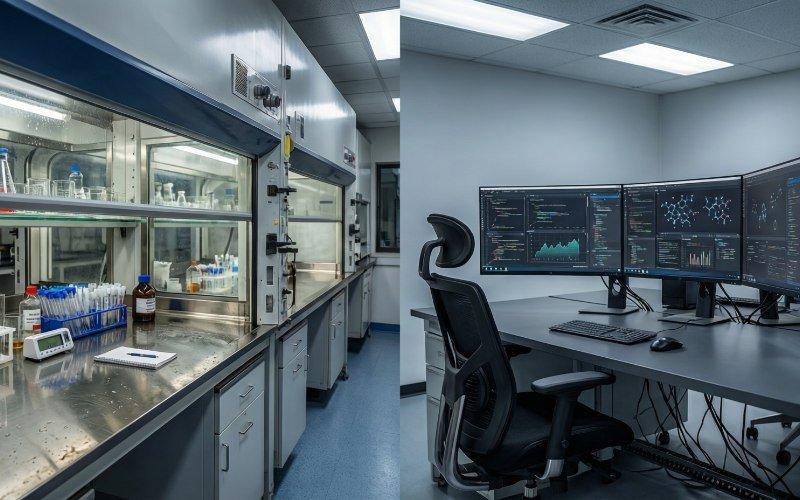
Laboratoires humides vs. laboratoires secs : différences fondamentales
La distinction entre laboratoires humides et secs est essentielle pour la planification des infrastructures. Les laboratoires humides sont conçus pour la manipulation de liquides, de matières biologiques et de produits chimiques. Ils nécessitent des surfaces de travail robustes, telles que la résine époxy ou la résine phénolique, conformes à la norme de résistance chimique SEFA 3. Selon la Scientific Equipment and Furniture Association (SEFA), la résine époxy résiste à des températures supérieures à 177 °C (350 °F) sans altération de sa structure.
Les laboratoires sans électrolyse sont dédiés à l'analyse informatique, à la physique ou à l'électronique. Ils privilégient les postes de travail ergonomiques et la protection contre les décharges électrostatiques (DES). Une étude de 2023 menée par l'International Facility Management Association (IFMA) a démontré que le mobilier modulaire dans ces laboratoires permettait d'optimiser l'utilisation de l'espace de 221 TP3T par rapport aux meubles fixes.
Environnements de laboratoire spécialisés
Salles blanches (normes ISO 14644)
Les salles blanches sont des environnements contrôlés où les polluants tels que la poussière et les micro-organismes en suspension dans l'air sont filtrés. Elles sont essentielles à la fabrication de semi-conducteurs et à la préparation de médicaments. La norme ISO 14644-1 définit les classes de salles blanches en fonction du nombre de particules par mètre cube d'air. Une salle blanche de classe ISO 5, par exemple, ne tolère pas plus de 3 520 particules de 0,5 micromètre par mètre cube.
Laboratoires de production et de contrôle qualité (CQ)
Les laboratoires de contrôle qualité sont intégrés aux processus de fabrication afin de garantir la conformité des produits aux normes prédéfinies. Dans l'industrie pharmaceutique, ces laboratoires opèrent selon les Bonnes Pratiques de Fabrication (BPF). D'après la FDA, le non-respect des exigences en matière de contrôles de laboratoire est l'une des principales causes des 483 lettres d'avertissement adressées aux fabricants.
“ La transition vers une conception de laboratoire modulaire et flexible n'est plus un luxe, mais une nécessité pour survivre aux changements rapides des cycles de recherche en biotechnologie ”, déclare le Dr Marcus Thorne, architecte principal des infrastructures chez ZH Lab Furniture, dans un rapport sectoriel de 2024.
Normes et infrastructures essentielles
Le bon fonctionnement d'un laboratoire repose sur le strict respect des normes internationales. La norme ANSI Z358.1 (American National Standards Institute) réglemente l'installation et le fonctionnement des douches et lave-yeux d'urgence. Les recherches indiquent qu'une décontamination immédiate, effectuée dans les 15 premières secondes suivant une exposition chimique, peut réduire la gravité des lésions tissulaires jusqu'à 60%.
De plus, la norme SEFA 8 relative au mobilier de laboratoire garantit la capacité des armoires à supporter des équipements lourds. Une armoire de base standard doit subir un test de charge de 907 kg (2 000 lb) sans défaillance pour obtenir la certification SEFA. Ce niveau de robustesse est essentiel pour les laboratoires d'analyse abritant des spectromètres de masse lourds pouvant peser plus de 181 kg (400 lb).
Sélection des matériaux critiques : comparaison des environnements de laboratoire
Dans la conception de laboratoires haute performance, la surface de travail constitue la première ligne de défense. Selon SEFA (Association des équipements et du mobilier scientifiques) Conformément aux directives, le choix des matériaux doit être dicté par les contraintes chimiques et thermiques spécifiques au type de laboratoire. matériaux pour les plans de travail de laboratoire types.
Comparaison stratégique : Données sur la performance des surfaces de travail
| Fonctionnalité | Résine phénolique | Une résine époxy | Acier inoxydable 316L |
| Résistance chimique | Élevé (Acides/Solvants) | Excellent (Alcali fort) | Modéré (Corrodé par les halogènes) |
| Résistance à la chaleur | Jusqu'à 160 °C | Jusqu'à 350 °C (ininflammable) | Excellent (Cryogénique à haute température) |
| Porosité | Non poreux | Monolithique (non poreux) | Porosité nulle (non absorbant) |
| Application standard | Laboratoires éducatifs et de R&D | Laboratoires d'analyse et de chimie | Clinique, Pharmaceutique et BSL-3/4 |
| Durée de vie typique | 10-15 ans | Plus de 20 ans | Durée de vie (Indestructible) |
La physique des flux d'air : exigences de ventilation par type de laboratoire
La ventilation efficace des laboratoires est régie par les lois de Dynamique des fluides. Chez ZH LAB, nous concevons des systèmes qui maintiennent une stricte différentiel de pression—généralement une pression négative de -12 Pa à -30 Pa par rapport aux couloirs des laboratoires à risque – afin de garantir qu’aucun air contaminé ne s’échappe de la zone primaire.
Systèmes CAV vs. VAV : L’écart d’efficacité
Volume d'air constant (CAV) :
Mécanisme: Évacue un volume d'air fixe 24h/24 et 7j/7.
Application: Petits laboratoires avec des charges chimiques constantes.
Inconvénient technique : Consommation énergétique élevée ; incapacité à s’adapter aux variations de hauteur des vantaux, pouvant entraîner une chute de la vitesse d’écoulement en dessous du seuil critique. 0,5 m/s seuil de sécurité.
Volume d'air variable (VAV) :
Mécanisme: Utilise des capteurs pour ajuster le flux d'air en fonction de la position de la vitre de la hotte.
Application: Pôles de R&D modernes et laboratoires d'analyse à haut débit.
Avantage technique : Réduit les coûts énergétiques jusqu'à 60% tout en maintenant une vitesse frontale constante, en assurant la conformité avec ISO 14644 et ASHRAE 110 protocoles de sécurité.
L'avis d'expert de ZH LAB : La philosophie de conception “ Zéro angle ”
Acquisition d'informations : Pourquoi la modularité traditionnelle échoue dans les environnements BSL-3 et BSL-4.
Bien que l’expression “ conception de laboratoires modulaires ” soit un terme à la mode dans le secteur des systèmes de laboratoire pour désigner la flexibilité, LABORATOIRE ZH‘évaluation technique de Cela révèle un défaut critique dans les environnements de confinement de haute sécurité (BSL-3/4). Le mobilier modulaire traditionnel repose sur des joints, des supports et des rails réglables qui créent micro-crevasses.
Dans un environnement de niveau de biosécurité 3, ces crevasses deviennent des “ réservoirs biologiques ” où les agents pathogènes peuvent survivre à la décontamination gazeuse (telle que le VHP – peroxyde d’hydrogène vaporisé).
La solution ZH LAB : Nous mettons en œuvre un “Conception intégrée ” Zero-Corner ». Cela implique :
Structures entièrement soudées en acier inoxydable 316L : Supprimer tous les éléments de fixation mécaniques.
Dosserets incurvés : Une courbe continue de 19 mm de rayon entre le plan de travail et le mur, garantissant l'absence d'angles droits susceptibles de favoriser la prolifération microbienne.
Jambes non proximales : Suspension des armoires via des consoles murales robustes pour permettre la visibilité du sol 100% et l'accès pour le nettoyage.
Questions fréquemment posées
Quel est le type de laboratoire le plus courant ?
Les laboratoires cliniques sont les plus courants, car ils sont essentiels aux systèmes de santé du monde entier pour traiter les tests des patients et fournir des données de diagnostic.
Quelle est la différence entre BSL-1 et BSL-2 ?
Les laboratoires BSL-1 manipulent des agents non pathogènes, tandis que les laboratoires BSL-2 manipulent des agents à risque modéré qui nécessitent un accès restreint et des enceintes de sécurité biologique pour les procédures générant des aérosols.
Pourquoi la certification SEFA est-elle importante pour le mobilier de laboratoire ?
La certification SEFA garantit que le mobilier de laboratoire répond à des normes rigoureuses de sécurité et de durabilité, protégeant ainsi le personnel contre les déversements de produits chimiques et les défaillances structurelles.
À quoi servent les salles blanches ?
Les salles blanches sont utilisées pour les procédés très sensibles à la contamination environnementale, tels que la fabrication de produits pharmaceutiques, la recherche biotechnologique et la production de microélectronique.
Quels sont les matériaux les plus courants pour les paillasses de laboratoire ?
Les matériaux les plus courants sont la résine époxy et la résine phénolique. La résine époxy est privilégiée dans les laboratoires de chimie pour son excellente résistance à la chaleur et aux produits chimiques, tandis que la résine phénolique est utilisée dans les laboratoires de biologie et cliniques pour ses propriétés antimicrobiennes et sa durabilité.
Pourquoi le mobilier de laboratoire modulaire devient-il la norme dans l'industrie ?
Le mobilier modulaire permet aux laboratoires d'adapter et de reconfigurer rapidement leurs espaces sans interruption significative. Face à l'évolution rapide des technologies, les laboratoires doivent souvent moderniser leurs équipements ou réorienter leurs recherches ; les systèmes modulaires permettent de réduire les coûts de rénovation à long terme d'environ 251 000 à 401 000 dollars taïwanais.
https://www.zhlabsfurniture.com/wp-content/uploads/2024/01/walk-in-fume-hood.jpg 400 400 racine https://www.zhlabsfurniture.com/wp-content/uploads/2026/08/zh-lab-logo-home-1.jpg racine2024-01-29 15:19:042026-05-09 14:59:46Promenade sous la hotte https://www.zhlabsfurniture.com/wp-content/uploads/2024/01/stainless-steel-fume-hood-for-laboratories.jpg 400 400 racine https://www.zhlabsfurniture.com/wp-content/uploads/2026/08/zh-lab-logo-home-1.jpg racine2024-01-29 14:50:142026-05-09 15:00:10Hotte en acier inoxydable
 https://www.zhlabsfurniture.com/wp-content/uploads/2024/01/bench-top-fume-hood.jpg 400 400 racine https://www.zhlabsfurniture.com/wp-content/uploads/2026/08/zh-lab-logo-home-1.jpg racine2024-01-29 14:32:162026-05-09 15:00:35Hotte éducative
 https://www.zhlabsfurniture.com/wp-content/uploads/2024/01/chemical-fume-hoods-1.jpg 400 400 racine https://www.zhlabsfurniture.com/wp-content/uploads/2026/08/zh-lab-logo-home-1.jpg racine2024-01-29 11:06:272026-05-09 15:01:43Hotte de chimie
 https://www.zhlabsfurniture.com/wp-content/uploads/2024/01/acid-fume-hood.jpg 400 400 racine https://www.zhlabsfurniture.com/wp-content/uploads/2026/08/zh-lab-logo-home-1.jpg racine2024-01-26 13:30:252026-01-29 21:25:25Hotte acide
 https://www.zhlabsfurniture.com/wp-content/uploads/2023/03/wood-lab-workstaion-casework.jpg 400 400 racine https://www.zhlabsfurniture.com/wp-content/uploads/2026/08/zh-lab-logo-home-1.jpg racine2023-01-03 13:10:482026-10-22 10:53:36Table de laboratoire en bois
 https://www.zhlabsfurniture.com/wp-content/uploads/2023/03/phenolic-resin-lab-bench.jpg 400 400 racine https://www.zhlabsfurniture.com/wp-content/uploads/2026/08/zh-lab-logo-home-1.jpg racine2023-01-02 13:12:472026-01-29 21:28:21Table de laboratoire en résine phénolique
 https://www.zhlabsfurniture.com/wp-content/uploads/2023/03/steel-lab-benches.jpg 400 400 racine https://www.zhlabsfurniture.com/wp-content/uploads/2026/08/zh-lab-logo-home-1.jpg racine2023-01-01 13:11:292026-05-09 14:52:44Table de laboratoire en acier
Dernières nouvelles
 Phenolic Resin Countertop Maintenance & Cleaning Guide2026-10-19 - 13:11
 Caractéristiques essentielles des bancs d'habillage performants destinés aux salles blanches européennes2026-07-15 - 11:03
 Avantages de l'utilisation de tables pour salles blanches dans les laboratoires : guide à l'intention des responsables de la planification et des concepteurs de laboratoires2026-06-27 - 21:19
 Les 10 principaux fabricants de mobilier de laboratoire en Chine (mise à jour 2026)2026-06-22 - 21:03

