
 https://www.zhlabsfurniture.com/wp-content/uploads/2024/01/walk-in-fume-hood.jpg 400 400 뿌리 https://www.zhlabsfurniture.com/wp-content/uploads/2026/08/zh-lab-logo-home-1.jpg 뿌리2024-01-29 15:19:042026-05-09 14:59:46흄후드를 걷다
이 기사는 당사의 Laboratory Safety & Compliance Knowledge Hub.
Key Takeaways
- Face velocity is the primary metric for ensuring chemical fume hood containment and user safety.
- The industry standard range is generally 80 to 100 feet per minute (fpm) for most applications.
- ANSI/ASSP Z9.5-2022 provides the leading regulatory framework for laboratory ventilation requirements.
- Variable Air Volume (VAV) systems offer significant energy savings compared to Constant Air Volume (CAV).
- ASHRAE 110 testing is mandatory to verify that velocity translates into actual containment performance.
What is the optimal Fume Hood Face Velocity for laboratory safety?
Face velocity is defined as the average speed of air moving into the fume hood opening. This measurement is typically expressed in feet per minute (fpm) or meters per second (m/s). For over three decades, the scientific community has debated the absolute ‘safe’ number for this metric. According to the OSHA 29 CFR 1910.1450 (Occupational Exposure to Hazardous Chemicals in Laboratories), employers must provide ventilation that ensures low exposure levels. While OSHA does not mandate a specific fpm, most safety professionals target 80 to 100 fpm.

Research indicates that velocities below 60 fpm are insufficient to overcome minor room drafts. Conversely, velocities exceeding 150 fpm can cause turbulence within the hood. This turbulence often leads to ‘roll-back’ eddies, which pull contaminants out of the hood into the user’s breathing zone. A 2023 study by the International Institute for Sustainable Laboratories (I2SL) suggests that 23% of containment failures occur due to excessive turbulence rather than low airflow. Therefore, maintaining a steady, laminar flow is far more important than simply increasing the motor speed.
How do OSHA and ANSI Z9.5 regulate laboratory ventilation?
The regulatory landscape for fume hoods is governed by several key organizations. ANSI/ASSP Z9.5-2022 is the most recognized standard for laboratory ventilation. It emphasizes that the required face velocity should be determined by the specific hazards present. SEFA 1-2010, the Scientific Equipment and Furniture Association standard, also provides guidelines on the construction and performance of these units. These standards collectively aim to ensure that chemical vapors are mitigated before they reach the laboratory environment.
According to [ANSI Z9.5], the hood must be able to contain the specific chemicals being used. This means that a standard 100 fpm might be adequate for common solvents, but highly toxic substances may require more specialized flow patterns. Statistics from industry audits show that nearly 15% of laboratories operate with outdated airflow settings. Failure to comply with these standards can result in significant fines and, more importantly, long-term health risks for laboratory personnel. Proper documentation of annual certification is a core requirement under these safety mandates.
Why is the ASHRAE 110 test essential for measuring containment?
While velocity is a useful indicator, it is not a direct measure of containment. The ASHRAE 110 test is the gold standard for verifying that a fume hood actually works. This protocol involves flow visualization using smoke tubes and tracer gas testing with sulfur hexafluoride (SF6). A hood may show a perfect 100 fpm but still leak tracer gas due to internal clutter or poor design. According to [ASHRAE] research, tracer gas leakage should not exceed 0.05 parts per million (ppm) during static testing.
“Optimizing face velocity is not just about safety compliance; it is about finding the delicate balance between containment integrity and sustainable laboratory operation costs,” says Dr. Robert Mitchell, Chief Safety Officer at LabTech Solutions (October 2024).
Factors such as ‘sash management’ significantly influence the outcome of ASHRAE 110 tests. When a sash is kept fully open, the volume of air required to maintain 100 fpm is maximized. When the sash is lowered, the opening area decreases, which can lead to higher velocities if the fan speed is not adjusted. High-performance hoods are now designed to operate safely at velocities as low as 60 fpm. These units utilize advanced aerodynamics and air-foil designs to maintain containment even at lower flow rates.
Technical Comparison: CAV vs. VAV Fume Hood systems
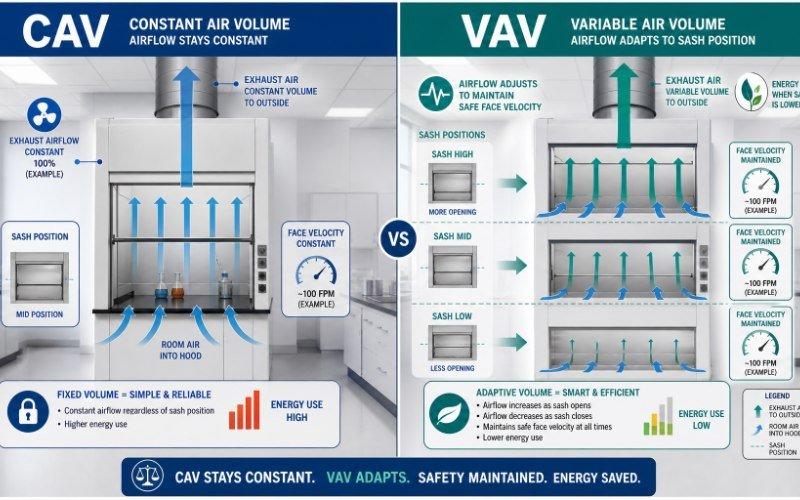
Choosing between Constant Air Volume (CAV) and Variable Air Volume (VAV) systems is a critical decision for lab infrastructure. CAV hoods pull the same amount of air regardless of sash position, which leads to massive energy waste. VAV systems use sensors and controllers to adjust the airflow based on the sash height. According to the U.S. Department of Energy, a single fume hood can consume as much energy as three average American homes, costing between $3,500 and $6,000 annually.
| 기능 | 정풍량(CAV) | 가변 풍량(VAV) |
|---|---|---|
| Face Velocity Control | Varies with sash position | Maintains constant velocity |
| Energy Efficiency | Low (Continuous high flow) | High (Reduces flow when closed) |
| Initial Setup Cost | Lower | Higher (Requires controllers/valves) |
| Containment Stability | Subject to sash-induced changes | Highly stable across sash range |
| Typical Annual ROI | N/A | 2 – 4 years |
The implementation of VAV systems has become the industry standard for new construction. By integrating these systems, laboratories can reduce their carbon footprint by up to 50%. However, VAV systems require more frequent maintenance of the velocity sensors and actuators. Regular calibration ensures that the response time of the system is less than 3 seconds. This rapid response is necessary to maintain the face velocity when a user quickly opens or closes the sash.
How do you measure and maintain Fume Hood Face Velocity?
Measuring face velocity requires precision instruments such as thermal anemometers. These devices can detect air speeds with an accuracy of +/- 2 fpm. To get an accurate average, technicians divide the sash opening into a grid of one-foot squares. A reading is taken at the center of each square, and the values are averaged. According to SEFA 1, no single reading should deviate by more than 20% from the overall average velocity.
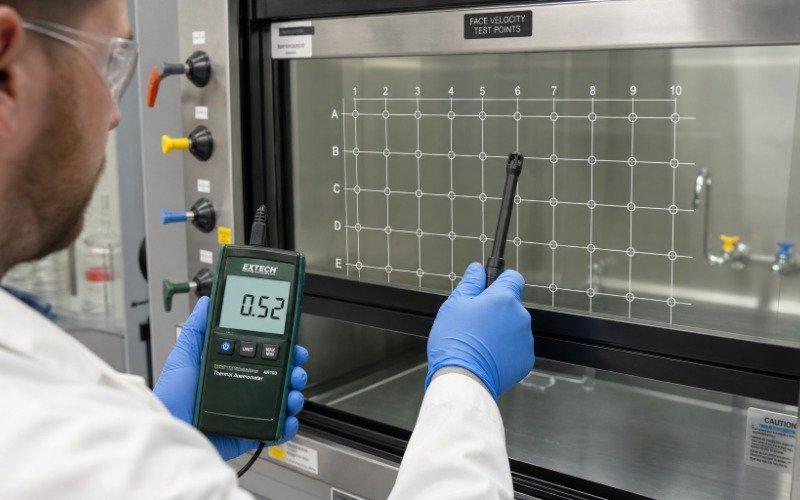
In addition to manual measurements, modern hoods are equipped with continuous airflow monitors. These monitors provide real-time feedback to the user via digital displays or color-coded lights. If the velocity drops below a safe threshold, an audible alarm should trigger immediately. Statistics from 2022 safety reports show that 31% of lab accidents involving fume hoods could have been prevented by functional airflow alarms. Ensuring these systems are tested monthly is a best practice for any safety-conscious laboratory.
What is the cost impact of high face velocity in 2026?
High face velocity does not always equate to better safety, but it always equates to higher costs. Each cubic foot per minute (CFM) of air exhausted from a building costs roughly $5 to $10 in conditioning energy. A standard six-foot fume hood running at 100 fpm with the sash fully open exhausts approximately 1,200 CFM. This results in an annual energy bill exceeding $7,000 for a single unit in many climates. Reducing the target velocity to 80 fpm can save up to 20% in energy costs without compromising safety.
According to [Lawrence Berkeley National Laboratory], widespread adoption of high-performance, low-flow hoods could save the U.S. research sector over $1 billion annually. These hoods are designed to operate at 60-70 fpm. They utilize sophisticated baffle systems to manage the internal airflow dynamics. By choosing ZH Lab Furniture’s advanced aerodynamic models, facilities can achieve both superior safety ratings and significant operational savings. The transition to low-flow technology is a key component of ‘Green Lab’ certification programs worldwide.
Best practices for sash height and worker safety
The sash is the most important safety feature of a fume hood. It serves as a physical shield between the researcher and the chemical reaction. Users should never work with the sash in the fully open position. Most hoods are designed to be operated at a ‘working height’ of 18 inches. Lowering the sash not only improves containment but also increases the face velocity in CAV systems. In VAV systems, it signals the exhaust fan to slow down, saving energy instantly.
Furthermore, internal clutter can severely disrupt the airflow patterns. Equipment should be placed at least 6 inches back from the sash opening. Large equipment should be elevated 2 to 3 inches on blocks to allow air to flow underneath. According to [NIOSH], poor equipment placement accounts for 40% of localized containment failures. Proper training on these aerodynamic principles is essential for every laboratory worker to ensure their own protection and the safety of their colleagues.
추천 상품
살펴보기 실험실 배기 후드 솔루션 →
FAQ
What is the recommended face velocity for a chemical fume hood?
The industry standard recommended face velocity is between 80 and 100 feet per minute (fpm). This range is widely supported by ANSI Z9.5 and SEFA guidelines to ensure adequate containment of hazardous vapors while minimizing turbulence.
Can a face velocity that is too high be dangerous?
Yes, face velocities exceeding 120-150 fpm can create turbulent air currents and eddies. These disruptions can pull hazardous fumes out of the hood and into the user’s breathing zone, effectively failing the containment mission.
How often should fume hood face velocity be tested?
Fume hoods should be certified and tested for face velocity at least once every 12 months. However, more frequent testing may be required for high-risk applications or if the hood has been moved or repaired.
https://www.zhlabsfurniture.com/wp-content/uploads/2024/01/walk-in-fume-hood.jpg 400 400 뿌리 https://www.zhlabsfurniture.com/wp-content/uploads/2026/08/zh-lab-logo-home-1.jpg 뿌리2024-01-29 15:19:042026-05-09 14:59:46흄후드를 걷다 https://www.zhlabsfurniture.com/wp-content/uploads/2024/01/stainless-steel-fume-hood-for-laboratories.jpg 400 400 뿌리 https://www.zhlabsfurniture.com/wp-content/uploads/2026/08/zh-lab-logo-home-1.jpg 뿌리2024-01-29 14:50:142026-05-09 15:00:10스테인레스 스틸 흄후드
 https://www.zhlabsfurniture.com/wp-content/uploads/2024/01/bench-top-fume-hood.jpg 400 400 뿌리 https://www.zhlabsfurniture.com/wp-content/uploads/2026/08/zh-lab-logo-home-1.jpg 뿌리2024-01-29 14:32:162026-05-09 15:00:35교육용 흄후드
 https://www.zhlabsfurniture.com/wp-content/uploads/2024/01/chemical-fume-hoods-1.jpg 400 400 뿌리 https://www.zhlabsfurniture.com/wp-content/uploads/2026/08/zh-lab-logo-home-1.jpg 뿌리2024-01-29 11:06:272026-05-09 15:01:43화학 흄후드
 https://www.zhlabsfurniture.com/wp-content/uploads/2024/01/acid-fume-hood.jpg 400 400 뿌리 https://www.zhlabsfurniture.com/wp-content/uploads/2026/08/zh-lab-logo-home-1.jpg 뿌리2024-01-26 13:30:252026-01-29 21:25:25산성 증기 후드


 한국어
한국어  English
  العربية
  Español
  Français
  Русский
  Deutsch
  हिन्दी
  Bahasa Indonesia
  日本語
日本語  മലയാളം
  Tiếng Việt
  ไทย
ไทย  简体中文
简体中文