
Einkaufsführer für Labormöbel: Lösungen für Schulen und Krankenhäuser & Forschungslabore
Die Auswahl der richtigen Laborinfrastruktur ist eine entscheidende Maßnahme, die sich auf Sicherheit, Arbeitsabläufe und langfristige Betriebskosten auswirkt. Ob Sie einen naturwissenschaftlichen Unterrichtsraum an einer High School modernisieren oder ein klinisch-pathologisches Zentrum ausstatten – das Verständnis der technischen Spezifikationen ist unerlässlich. Dieses umfassende Einkaufsführer für Labormöbel Ziel ist es, Ihren Beschaffungsprozess zu optimieren. Wir werden die Unterschiede zwischen Bildungseinrichtungen, sterilen medizinischen Umgebungen und Hochleistungs-Forschungsarbeitsplätzen untersuchen.
Definition der Kernanforderungen Ihrer Einrichtung
Bevor Sie sich für ein bestimmtes Workstation-Modell entscheiden, müssen Sie zunächst die Hauptfunktion Ihres Labors definieren. Unterschiedliche Umgebungen erfordern sehr unterschiedliche Materialeigenschaften und Konstruktionskonfigurationen. Daher kann eine Lösung, die für eine Universität geeignet ist, in einem klinischen Umfeld versagen.
1. Bildungseinrichtungen (Grund- und weiterführende Schulen sowie Universitäten)
Schulen benötigen Möbel, die extreme Langlebigkeit mit Wirtschaftlichkeit vereinen. Da Schüler die Geräte oft nicht gerade schonend behandeln, sind Kratzfestigkeit und Stoßfestigkeit von größter Bedeutung. Darüber hinaus ist Flexibilität in fächerübergreifenden Klassenzimmern häufig erforderlich.
- Priorität: Stoßfestigkeit, Sicherheit der Schüler und Budgetoptimierung.
- Empfohlenes Material: Phenolharz oder feste physikalisch-chemische Platten.
- Layout: Inselbänke erleichtern Gruppenarbeit und die Aufsicht durch die Lehrkräfte.
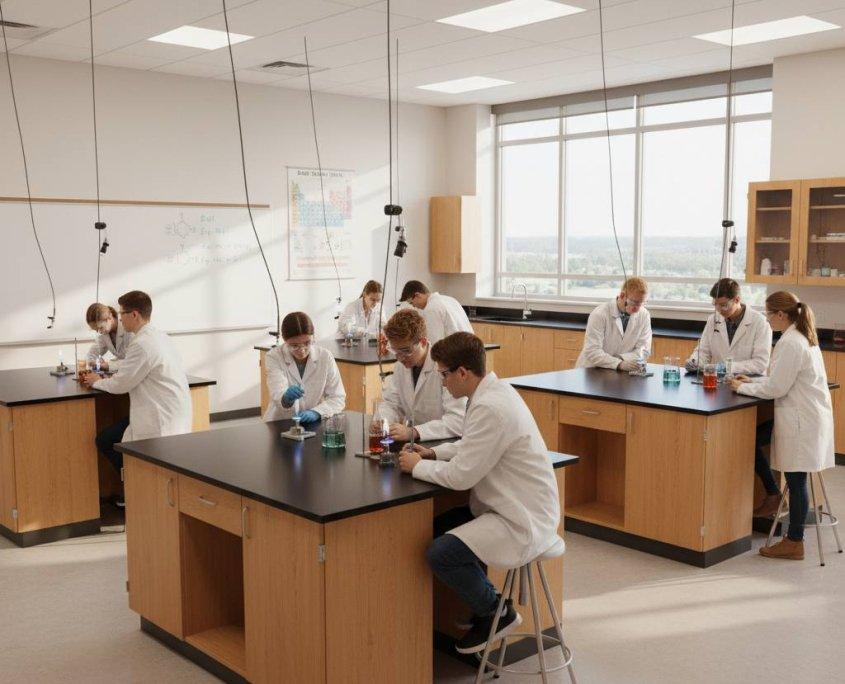
2. Krankenhäuser und medizinisch-pathologische Labore
Im Gegensatz zu Schulen legen medizinische Einrichtungen größten Wert auf Sterilität und Chemikalienbeständigkeit. Pathologische und histologische Labore arbeiten häufig mit biologischen Flüssigkeiten und aggressiven Desinfektionsmitteln. Daher sind nicht poröse Oberflächen unerlässlich, um Bakterienwachstum zu verhindern.
- Priorität: Hygiene, einfache Reinigung und biologische Beständigkeit.
- Empfohlenes Material: Edelstahl der Güteklasse 304 oder 316.
- Einhaltung: Strenge Hygienevorschriften müssen eingehalten werden.
3. Forschungs- und industrielle F&E-Zentren
Forschungseinrichtungen sind oft extremen chemischen Belastungen ausgesetzt. Von flüchtigen organischen Verbindungen bis hin zu konzentrierten Säuren – die Möbel müssen widerstandsfähig sein. Zudem benötigen diese Labore häufig modulare Systeme, um sich an wechselnde Forschungsprojekte anpassen zu können.
Materialauswahl für Arbeitsplatten: Die technische Aufschlüsselung
Die Arbeitsplatte ist der wichtigste Bestandteil Ihres Labortisch. Die Wahl des falschen Materials kann innerhalb weniger Jahre zu kostspieligen Ersatzlieferungen führen. Im Folgenden vergleichen wir die gängigsten Materialien der Branche.
Epoxidharz: Der Industriestandard
Epoxidharz ist ein monolithisches Material, das heißt, es ist durchgehend einheitlich. Es bietet eine hervorragende Beständigkeit gegenüber hohen Temperaturen und aggressiven Chemikalien. Allerdings ist es schwerer und teurer als andere Optionen.
Phenolharz: Die vielseitige Wahl
Phenolharz ist leichter und einfacher zu verarbeiten als Epoxidharz. Es bietet eine ausgezeichnete Chemikalienbeständigkeit, kann aber bei extremer Hitze (über 177 °C) Oberflächenschäden erleiden. Für die meisten Labore mit allgemeinen Anforderungen stellt es ein optimales Verhältnis von Leistung und Preis dar.
Keramik: Der Hitzemeister
Für Hochtemperaturexperimente im Labor ist Keramik die beste Wahl. Sie ist nahezu hitzebeständig und äußerst kratzfest. Allerdings kann sie bei Stößen durch schwere Gegenstände spröde werden.

Um Ihnen die Entscheidungsfindung zu erleichtern, haben wir eine detaillierte Leistungsvergleichstabelle zusammengestellt.
| Merkmal | Epoxidharz | Phenolharz | Rostfreier Stahl | Keramik |
|---|---|---|---|---|
| Chemische Beständigkeit | Ausgezeichnet | Sehr gut | Gut | Ausgezeichnet |
| Hitzebeständigkeit | Hoch | Mäßig | Hoch | Extrem |
| Kratzfestigkeit | Gut | Sehr gut | Mäßig | Ausgezeichnet |
| Bakterielle Resistenz | Gut | Gut | Am besten | Ausgezeichnet |
| Kosten | Hoch | Mäßig | Hoch | Hoch |
Tragwerksysteme: C-Rahmen vs. H-Rahmen
Sobald die Arbeitsplatte ausgewählt ist, muss die Unterkonstruktion berücksichtigt werden. Das Gestell bestimmt die Tragfähigkeit und die Flexibilität der Laboreinrichtung. Stahlgestelle werden üblicherweise zum Schutz vor Korrosion mit Epoxidharz pulverbeschichtet.
C-Rahmen-Systeme
C-Rahmen-Systeme bieten viel Beinfreiheit und ermöglichen die mobile Installation von Unterschränken. Sie sind aufgrund ihrer Modularität und der einfachen Reinigung des Bodens unter der Werkbank beliebt. Daher erfreuen sie sich großer Beliebtheit in modernen Forschungslaboren, in denen Flexibilität entscheidend ist.
H-Rahmen-Systeme
H-Rahmenkonstruktionen bieten überlegene Stabilität und hohe Tragfähigkeit. Wenn in Ihrem Labor schwere Instrumente wie Massenspektrometer oder Zentrifugen eingesetzt werden, ist ein H-Rahmen erforderlich. Im Vergleich zu C-Rahmen bieten sie jedoch weniger Flexibilität beim Verschieben von Schränken.

Sicherheitsstandards und Compliance im Alltag meistern
Bei der Beschaffung von Labormöbeln geht es nicht nur um Ästhetik, sondern auch um die Einhaltung gesetzlicher Bestimmungen und Sicherheitsvorschriften. Ihr gewählter Lieferant muss internationale Standards erfüllen. Zum Beispiel die Verband für wissenschaftliche Geräte und Möbel (SEFA) setzt strenge Richtlinien für Belastungstests, chemische Oberflächenprüfungen und die strukturelle Integrität der Schränke.
Stellen Sie außerdem sicher, dass Ihre Abzugshauben die ASHRAE-110-Normen für Rückhaltesysteme erfüllen. Wenn Sie in den Vereinigten Staaten ansässig sind, müssen Sie die folgenden Vorschriften einhalten: OSHA Die Vorschriften zur Laborsicherheit sind verbindlich. Die Missachtung dieser Zertifizierungen kann zu nicht bestandenen Prüfungen und Gefährdung der Personalsicherheit führen.
Budgetierung und Gesamtbetriebskosten
Bei der Budgetplanung sollten Sie nicht nur den Anschaffungspreis berücksichtigen. Günstigere Materialien zersetzen sich oft schnell bei Kontakt mit aggressiven Reagenzien, was zu frühzeitigen Ersatzkosten führt. Daher kann die Investition in hochwertiges Epoxidharz oder Edelstahl über einen Zeitraum von 10 Jahren zu niedrigeren Gesamtbetriebskosten (TCO) führen.
Berücksichtigen Sie außerdem die Versandlogistik und die Montage. Modulare Möbel verursachen aufgrund ihrer flachen Verpackung oft geringere Versandkosten. Vollverschweißte H-Rahmen hingegen benötigen mehr Platz, lassen sich aber vor Ort schneller montieren.
Fazit: Die richtige Wahl treffen
Ob Sie ein Universitätslabor oder ein Pathologiezentrum ausstatten – die Details sind entscheidend. Indem Sie die Materialleistung priorisieren, die Belastungsanforderungen verstehen und auf die Einhaltung der SEFA-Richtlinien bestehen, gewährleisten Sie eine sichere und produktive Arbeitsumgebung. Benötigen Sie Unterstützung bei der optimalen Raumplanung für Ihre Einrichtung? Unser Ingenieurteam hilft Ihnen gerne.
 https://www.zhlabsfurniture.com/wp-content/uploads/2023/03/wood-lab-workstaion-casework.jpg 400 400 Wurzel https://www.zhlabsfurniture.com/wp-content/uploads/2026/08/zh-lab-logo-home-1.jpg Wurzel2023-01-03 13:10:482026-10-22 10:53:36Labortisch aus Holz
 https://www.zhlabsfurniture.com/wp-content/uploads/2023/03/phenolic-resin-lab-bench.jpg 400 400 Wurzel https://www.zhlabsfurniture.com/wp-content/uploads/2026/08/zh-lab-logo-home-1.jpg Wurzel2023-01-02 13:12:472026-01-29 21:28:21Phenolharz-Labortisch
 https://www.zhlabsfurniture.com/wp-content/uploads/2023/03/steel-lab-benches.jpg 400 400 Wurzel https://www.zhlabsfurniture.com/wp-content/uploads/2026/08/zh-lab-logo-home-1.jpg Wurzel2023-01-01 13:11:292026-05-09 14:52:44Labortisch aus Stahl


