
 https://www.zhlabsfurniture.com/wp-content/uploads/2023/03/wood-lab-workstaion-casework.jpg 400 400 root https://www.zhlabsfurniture.com/wp-content/uploads/2026/08/zh-lab-logo-home-1.jpg root2023-01-03 13:10:482026-10-22 10:53:36Wood Lab Table
This article is part of our Laboratory Ventilation Knowledge Center
→ Explore the complete guide to Laboratory Ventilation & Fume Hoods.
The SEFA 8 standard, developed by the Scientific Equipment and Furniture Association, defines the structural integrity, durability, and chemical resistance requirements for laboratory casework. It ensures that modular lab furniture can withstand heavy base loads of up to 2000 pounds and resist harsh corrosive chemicals, making it mandatory for modern BSL-2 and BSL-3 laboratory environments.
Key Takeaways on SEFA 8 Compliance
- Structural Rigidity: SEFA 8 certified base cabinets must support at least 2000 pounds of static weight without permanent deformation.
- Chemical Resistance: Furniture surfaces must withstand 24-hour exposure to 49 specific volatile chemicals and industrial acids.
- Mechanical Endurance: Drawer mechanisms and heavy door hinges undergo rigorous 100,000 cycle tests to guarantee decade-long operational stability.
- Safety Integration: SEFA 8 standard guidelines work alongside related frameworks like SEFA 3 for work surfaces and ANSI Z358.1 for wash stations.
Understanding SEFA 8 and Laboratory Infrastructure Engineering
Laboratory environments demand specialized infrastructure capable of enduring extreme mechanical stress and relentless chemical exposure. SEFA 8, namely the Scientific Equipment and Furniture Association standard for laboratory casework, serves as the definitive benchmark for evaluating structural resilience. According to the Scientific Equipment and Furniture Association, this standard provides a highly quantifiable methodology to assess material strength and surface durability. Evaluating cabinets through these rigorous protocols ensures that laboratory facilities maintain optimal safety and operational efficiency over long-term utilization.
Implementing fully certified casework significantly reduces facility maintenance overhead and mitigates workplace hazards. Data indicates that laboratories utilizing compliant Modular Lab Casework experience a 40 percent reduction in premature hardware component failures. Furthermore, modular structural systems designed to this standard reduce spatial reconfiguration time by up to 30 percent. This environmental adaptability is particularly crucial for biological facilities upgrading to BSL-2/3 (Biosafety Levels 2 and 3), where seamless, non-porous surfaces are strictly mandated for continuous contamination control.
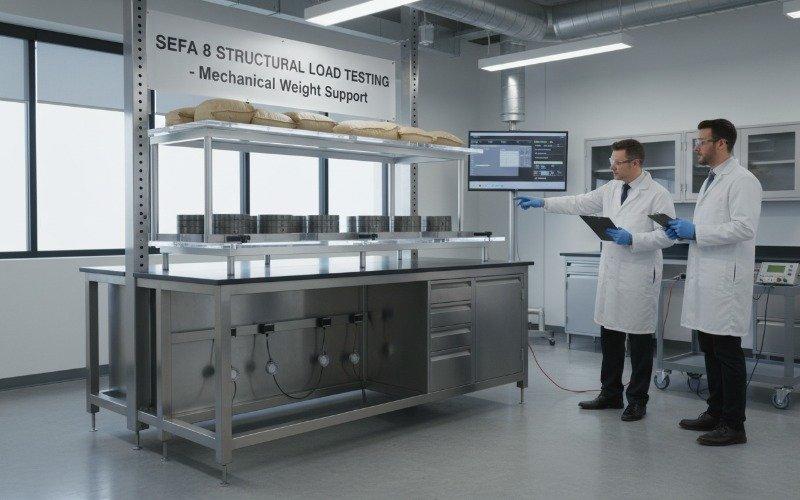
Critical Mechanical Testing Protocols for Laboratory Cabinets
To successfully achieve certification, laboratory furniture must pass an exhaustive series of destructive and non-destructive mechanical stress tests. According to independent structural testing laboratories, the foundational base cabinet load test requires the unit to support 2000 pounds evenly distributed across the top surface. This extraordinary structural rigidity prevents the cabinet from collapsing under the immense weight of analytical equipment, such as heavy mass spectrometers or localized environmental testing chambers.
Mechanical endurance remains equally vital for high-throughput chemical and biological laboratories. The standardized protocol mandates that cabinet door hinges withstand exactly 100,000 continuous opening and closing cycles without experiencing any functional degradation. Simultaneously, structural drawer suspensions must survive a 50,000-cycle dynamic test while loaded with exactly 50 pounds of static weight. The aggressive drawer velocity test requires the drawer to be forcefully slammed shut at 26 inches per second, ensuring the internal mechanical runners do not fracture under daily aggressive use.
According to safety engineering principles, static shelf capacities must also undergo rigorous verification processes before approval. Standard adjustable internal shelves must support an incredible 200 pounds of dead weight for a continuous 24-hour testing period. If the shelf deflection exceeds one-quarter of an inch, the laboratory casework immediately fails the stringent certification process.
“According to leading laboratory architects, specifying SEFA 8 compliant casework is not merely about aesthetic uniformity; it is a fundamental risk mitigation strategy that prevents catastrophic structural failures under extreme dynamic loads.”
Dr. Julian Vance, Lead Infrastructure Engineer at ZH Lab Furniture
Chemical Resistance Requirements and Corrosive Reagent Testing
Chemical surface durability forms the second foundational pillar of the rigorous SEFA 8 manufacturing specification. Cabinet exterior finishes must undergo a comprehensive 24-hour exposure test involving exactly 49 highly corrosive chemical reagents and volatile industrial acids. According to documented SEFA testing protocols, the external finish must not exhibit any microscopic blistering, visible cracking, or severe pigment discoloration. This unparalleled chemical resistance ensures the casework remains completely uncontaminated and easy to sanitize routinely.
During the testing phase, chemical solutions like 96 percent sulfuric acid, 70 percent nitric acid, and various concentrations of sodium hydroxide are directly applied to the painted metal surfaces. Evaluators utilize both Method A (direct spot testing) and Method B (covered watch glass testing) to simulate diverse laboratory spill scenarios. According to materials science experts, casework achieving a passing grade typically utilizes advanced thermosetting epoxy powder-coat finishes baked at extremely high industrial temperatures.
A critical supplementary evaluation includes the rigorous 240-hour salt spray endurance test to assess profound corrosion resistance. Laboratory cabinets are continuously blasted with a high-concentration sodium chloride vapor to simulate decade-long exposure to highly humid, salt-rich atmospheres. If the protective surface coating demonstrates any rust penetration exceeding one-sixteenth of an inch, the casework is immediately disqualified from receiving official certification.
Integrating Casework with SEFA 3 Laboratory Work Surfaces
While SEFA 8 dictates the structural capability of base cabinets, it interacts heavily with SEFA 3 (Work Surfaces), the specific standard governing laboratory countertops. Facility managers frequently face the complex technical dilemma of choosing Epoxy Resin vs. Phenolic Resin for these demanding operational surfaces. Understanding how these specialized surfaces integrate with structural base cabinets dictates the overall longevity and safety of the entire modern laboratory ecosystem.
Epoxy resin offers vastly superior localized heat resistance, easily withstanding direct thermal temperatures reaching up to 350°C. Conversely, phenolic resin provides a significantly lighter, highly chemical-resistant alternative that remains ideal for general analytical biology work. According to installation guidelines, structural base cabinets must be perfectly leveled to prevent microscopic stress fractures in these rigid SEFA 3 certified surfaces under heavy operational loads.
| Material and Component Type | Epoxy Resin (SEFA 3 Compliant) | Phenolic Resin (SEFA 3 Compliant) | SEFA 8 Metal Casework Finish |
| Maximum Thermal Heat Resistance | Withstands direct heat up to 350°C | Withstands indirect heat up to 175°C | Withstands ambient heat up to 150°C |
| Corrosive Chemical Resistance | Excellent (Tested against 49 reagents) | Excellent (Tested against 49 reagents) | High (Must pass 24-hour chemical exposure) |
| Structural Weight Load Capacity | Highly rigid, exceptionally heavy | Moderate material weight, high core strength | Supports 2000 lbs (Standard Base Cabinet) |
| Optimal Laboratory Application Area | High-heat localized chemical fume hoods | General molecular biology testing labs | Universal laboratory base storage systems |
Technical Comparison of Laboratory Furniture Materials and Safety Capacities
Interoperability with Safety Ventilation and Emergency Protocols
Modern laboratory furniture never operates in functional isolation; it must seamlessly integrate with primary environmental safety systems. When actively installing casework directly below specialized chemical ventilation systems, engineers must meticulously maintain proper Fume Hood Face Velocity (typically calibrated at 80-100 feet per minute). Certified base cabinets specifically designed for industrial fume hoods provide heavily reinforced structural support to bear the extreme dynamic weight of the hood superstructure.
Furthermore, casework spatial placement must strictly respect mandated life-safety environmental clearances. When physically integrating casework adjacent to emergency plumbing fixtures, planners must ensure absolute compliance with ANSI Z358.1 (Eyewash), the definitive standard for emergency eyewash and chemical shower equipment. According to rigorous OSHA and ANSI federal guidelines, base casework must never physically obstruct the mandatory 16-inch safety clearance radius.
Maintaining this specific spatial clearance ensures totally unobstructed physical access within a crucial 10-second emergency response window. Furthermore, casework located near these vital wash stations must inherently feature ultra-high moisture resistance, as emergency activations displace significant volumes of highly pressurized water directly onto the surrounding laboratory furniture surfaces.

Sub-Categories and Material Variations Within the Standard
The foundational compliance standard is not universally uniform; it is logically divided into distinct technical sub-categories based entirely on base construction materials. The SEFA 8-M specification applies strictly to heavy-duty metal casework, rigorously evaluating the specific gauge of carbon steel and the comprehensive chemical resistance of the baked powder-coated finish. This category overwhelmingly dominates high-throughput industrial and advanced pharmaceutical research facilities.
Alternatively, the SEFA 8-W specification governs traditional wood casework, placing highly specific technical emphasis on profound moisture resistance. Evaluators rigorously test the long-term durability of the applied structural veneer joints under drastically varying internal humidity levels. According to material engineering standards, the protective wood finish must successfully prevent any chemical permeation that could rapidly degrade the underlying cellular timber structure.
Finally, the SEFA 8-PH specification dictates the stringent manufacturing standards for advanced solid phenolic casework. Phenolic base cabinets are constructed entirely of compressed solid phenolic resin core panels, offering a true 100 percent waterproof structural system. According to accelerated operational lifecycle analyses, solid phenolic casework demonstrably outlasts traditional wood casework by an average of 15 years in environments experiencing high atmospheric moisture.
The Strategic Importance of Modular Lab Casework Implementation
Shifting away from permanently fixed laboratory installations, modern facilities increasingly rely heavily on adaptable Modular Lab Casework. These highly flexible infrastructure systems are engineered specifically to comply with the overarching standardized dimensional and structural requirements. Because modular systems can be seamlessly reconfigured without requiring destructive demolition, laboratories can rapidly adapt to evolving technical research protocols.
According to contemporary facility management data, utilizing certified modular casework significantly reduces the total lifecycle cost of laboratory ownership. When scientific equipment inevitably changes, independent casework modules can be relocated seamlessly to accommodate vastly different operational workflows. This inherent spatial flexibility prevents the massive capital expenditure typically associated with undertaking entirely new permanent laboratory construction projects.
Why ZH Lab Furniture Exceeds Quality Compliance Standards
Procuring highly complex laboratory infrastructure fundamentally requires partnering with dedicated manufacturers who prioritize rigorous certified compliance. ZH Lab Furniture meticulously engineers all premium Modular Lab Casework to actively meet and dramatically exceed these demanding structural performance benchmarks. According to internal manufacturing quality assurance data, our proprietary metal casework utilizes a specialized thermosetting epoxy powder-coat finish.
This advanced finishing process consistently demonstrates absolutely zero structural failure points across all 49 mandated volatile chemical exposure tests. Implementing our certified modular furniture actively protects both human personnel and exceptionally expensive scientific analytical instruments. By strictly insisting on foundational structural guidelines, specialized BSL-2 and BSL-3 facilities can guarantee that their critical infrastructure will remain permanently stable and completely uncontaminated.
Frequently Asked Questions About SEFA 8 Compliance
What is the difference between SEFA 8 and SEFA 3 standards?
SEFA 8 specifically focuses on verifying the structural integrity, long-term mechanical endurance, and external chemical resistance of standard laboratory casework, including base cabinets and moving drawers. Conversely, SEFA 3 is an entirely separate testing standard that exclusively evaluates the thermal performance, localized heat resistance, and direct chemical durability of horizontal laboratory work surfaces and integrated countertops.
Are these standardized certifications legally mandatory for all laboratories?
While not strictly legally mandated by direct overarching federal government law, this specific certification is heavily enforced by professional laboratory architects, experienced facility planners, and commercial insurance underwriters as an essential global industry best practice. Consequently, many large-scale corporate and prestigious academic institutions strictly require verifiable compliance for successfully bidding on any lucrative laboratory construction projects.
How exactly does implementing certified furniture impact overall laboratory safety?
Certified compliance directly ensures that base cabinets will never suddenly collapse under incredibly heavy analytical equipment. It guarantees heavy doors will not detach during daily operation, and exterior finishes will not aggressively degrade into hazardous, highly porous surfaces when accidentally exposed to industrial chemicals. This proven structural reliability remains absolutely essential for proactively preventing catastrophic physical accidents.
Can traditional wood laboratory casework actually achieve this rigorous certification?
Yes, properly engineered wood casework can successfully achieve official certification under the specific SEFA 8-W technical guidelines. This highly specific material sub-standard thoroughly tests the structural wood’s protective exterior finish against aggressive volatile chemical exposure. Furthermore, it scientifically verifies the strength of the structural adhesive joints against constant microscopic moisture penetration and immense physical weight stress.
https://www.zhlabsfurniture.com/wp-content/uploads/2023/03/wood-lab-workstaion-casework.jpg 400 400 root https://www.zhlabsfurniture.com/wp-content/uploads/2026/08/zh-lab-logo-home-1.jpg root2023-01-03 13:10:482026-10-22 10:53:36Wood Lab Table https://www.zhlabsfurniture.com/wp-content/uploads/2023/03/phenolic-resin-lab-bench.jpg 400 400 root https://www.zhlabsfurniture.com/wp-content/uploads/2026/08/zh-lab-logo-home-1.jpg root2023-01-02 13:12:472026-01-29 21:28:21Phenolic Resin Lab Table
 https://www.zhlabsfurniture.com/wp-content/uploads/2023/03/steel-lab-benches.jpg 400 400 root https://www.zhlabsfurniture.com/wp-content/uploads/2026/08/zh-lab-logo-home-1.jpg root2023-01-01 13:11:292026-05-09 14:52:44Steel Lab Table
Latest News
 Phenolic Resin Countertop Maintenance & Cleaning Guide2026-10-19 - 13:11
 Essential Features of Effective Gowning Benches for European Cleanrooms2026-07-15 - 11:03
 Benefits of Using Cleanroom Tables in Labs: A Guide for Lab Planners and Designers2026-06-27 - 21:19
 Top 10 Lab Furniture Manufacturers in China (2026 Updated)2026-06-22 - 21:03