
Laboratory Countertops
Selecting the right laboratory countertop material is critical for safety, durability, and maintenance. ZH Labs Furniture offers four premium options: Epoxy Resin, Phenolic Resin (Solid Phenolic), Ceramic, and Stainless Steel. Below we compare each material to help you make an informed decision.
It is made from quality epoxy resin and quartz sand. Processed by being vacuumed and being baked under high temperature of around 200 degrees. It is allowed to polish by emery paper when somewhere is corroded by chemical. Epoxy is available in Black with optional colors for an additional charge.
Epoxy resin is the top choice for chemical labs demanding extreme corrosion resistance. It is a homogeneous material – color and performance go all the way through.
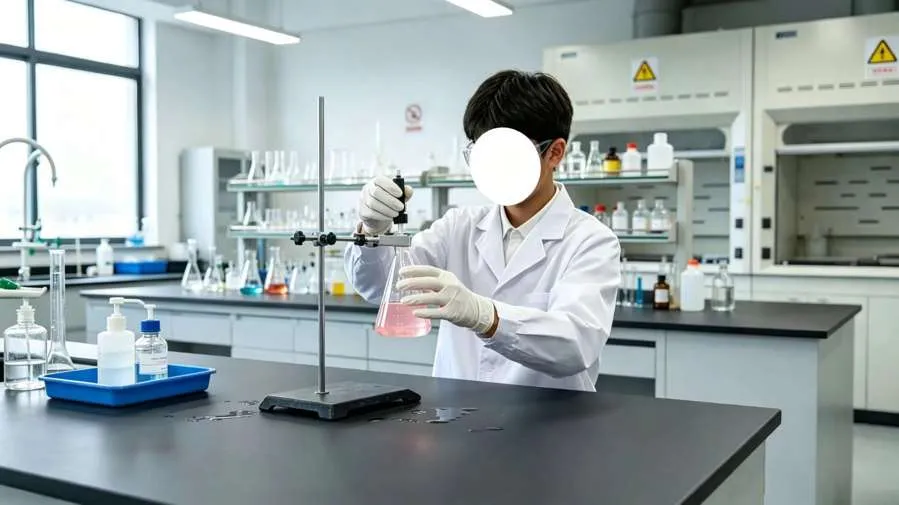
Key Features of Epoxy Resin Lagb Countertop:
- Excellent resistance to strong acids, alkalis, solvents.
- Short-term heat tolerance up to 600°C.
- Seamless installation, no liquid penetration.
- Repairable and refinishable.
- Thickness: 16mm, 19mm, 25mm.
- Colors: black, dark grey, light grey, blue, green (custom)
Epoxy Lab Worktop Applications:
- University chemistry labs
- Pharmaceutical R&D
- Analytical testing labs
- Electroplating labs
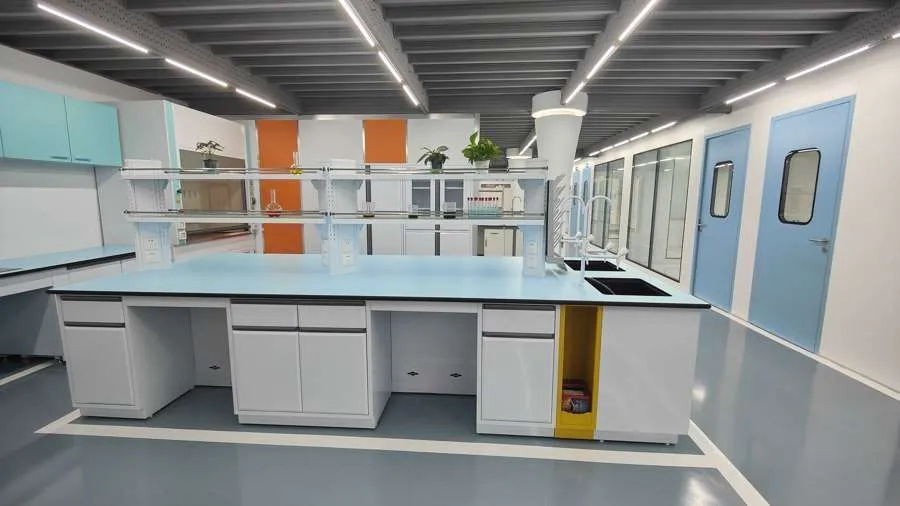
Phenolic resin countertops (also called chemical-resistant laminate) offer a good balance between performance and cost, widely used in educational and general labs.
It is made from a composite consisting of multiple layers of selected papers impregnated with special phenolic resins. Countertops are manufactured under heat and pressure to form a solid black chemical and corrosion-resistant composite throughout the entire thickness. Different colors and thicknesses are available. The black core is standard.
Key Features of Phenolic Resin Lab Countertop:
- Moderate chemical resistance (common acids/alkalis, alcohols).
- Scratch-resistant electron beam cured surface.
- Heat tolerance up to 180°C short-term.
- Affordable and available in many colors/patterns.
- Thickness: 13mm, 16mm, 19mm.
Phenolic Resin Worktop Applications:
- School labs (chemistry/biology)
- Food testing prep rooms
- Environmental labs
Ceramic countertops are fired at over 1200°C, offering the highest chemical and heat resistance among all materials. They are virtually impervious to all chemicals except hydrofluoric acid.
It is mainly used for balance table with black finish. Perfect performance on hot resistant, but not good for chemical resistant.
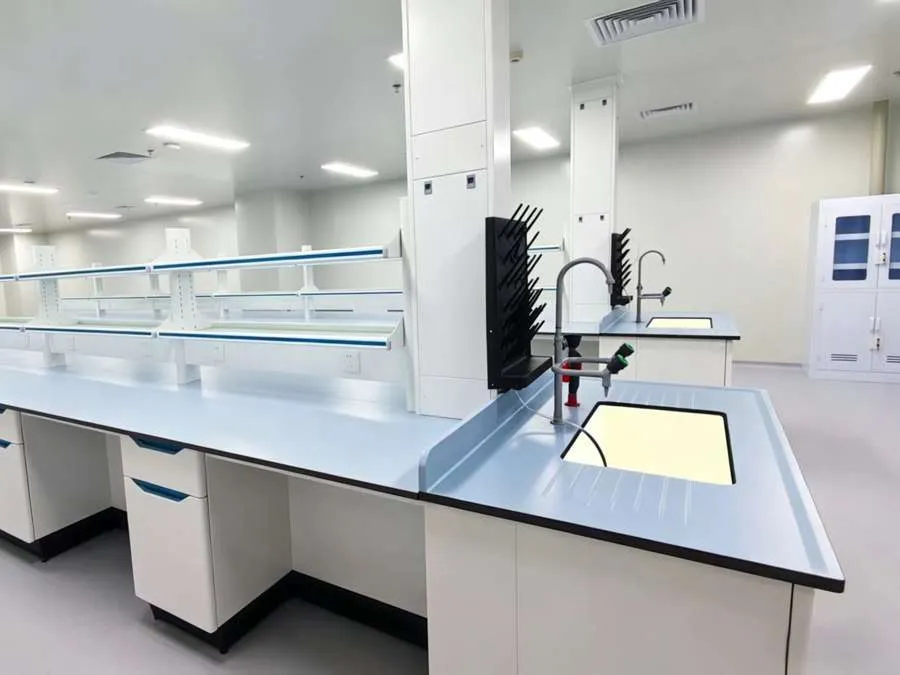
Key Features of Ceramic Lab Worktop:
- Outstanding chemical resistance (including aqua regia, concentrated sulfuric acid).
- Extreme heat resistance up to 1300°C.
- Mohs hardness 7-8, scratch-proof.
- Non-aging, easy to clean like glass.
- Disadvantage: Brittle, high cost, heavy.
Ceramic Laboratory Countertop Applications:
- Heavy chemical labs
- High-temperature labs (next to muffle furnaces)
- Materials research labs.
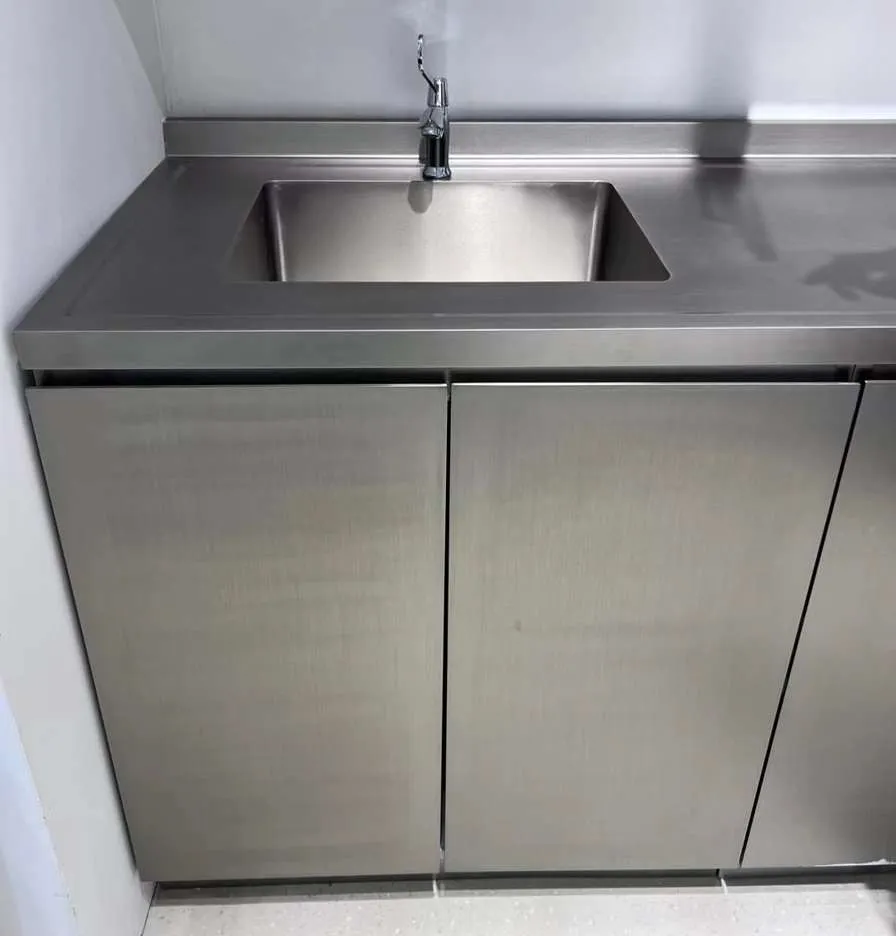
Countertops are formed from 304 stainless with reinforcement channels on the underside for added strength and rigidity. Backsplash are formed integrally with the countertop.
Stainless steel countertops are ideal for cleanrooms, hospital labs, and food testing facilities where hygiene and impact resistance are priorities.
Key Features of Stainless Steel Lab Countertop:
- Heat resistant up to 800°C+.
- Excellent impact resistance.
- Non-porous, easy to sterilize (alcohol, disinfectants).
- Common grades: 304 (food grade), 316 (better acid resistance).
- Disadvantage: Sensitive to strong acids/chlorides (304 may rust), shows fingerprints.
Stainless Lab Worktop Applications:
- Hospital clinical labs
- Cleanrooms
- Pharmaceutical production
- Animal labs
- Food labs
Laboratory Countertops Specification
| Property | Epoxy | Phenolic | Ceramic | Stainless Steel |
| Strong acid/alkali resistance | ★★★★★ | ★★★ | ★★★★★ | ★★★(304)/★★★★(316) |
| Heat resistance | ★★★★ (600℃) | ★★★(180℃) | ★★★★★ (1300℃) | ★★★★★ (800℃+) |
| Impact resistance | ★★★★ | ★★★ | ★★ | ★★★★★ |
| Ease of cleaning | ★★★★ | ★★★★ | ★★★★★ | ★★★★★ |
| Price (low to high) | ★★★★ | ★★★★ | ★★★★★ | ★★★★★ |
| Thickness | 16/19/25 mm | 12.7/16/19/25 mm | 15/18/40 mm | 21mm |
| Best for chemical labs | Most recommended | Moderate | Most recommended | Not recommended (strong acid) |
| Best for cleanroom /biology | Fair | Fair | Recommended | Most recommended |


How to Choose?
- Define your experiments: Strong acids? High heat? Sterile environment?
- Budget: Phenolic & epoxy resin aremost economical; Ceramic are premium but long-lasting.
- Existing equipment: Muffle furnaces →ceramic.
Black epoxy countertops and phenolic countertops are more popular compare with other colors. They are more economical and good chemical-resistant performance.
Contact us for free samples, on-site testing available.
Lab Countertop PDF Download

Contact Us Today
 https://www.zhlabsfurniture.com/wp-content/uploads/2023/03/stainless-steel-table-with-cabinet.jpg 400 400 root https://www.zhlabsfurniture.com/wp-content/uploads/2026/08/zh-lab-logo-home-1.jpg root2023-01-05 13:15:302026-10-07 20:39:58Stainless Steel Table with Cabinet
 https://www.zhlabsfurniture.com/wp-content/uploads/2023/03/stainless-steel-clean-room-tables.jpg 500 500 root https://www.zhlabsfurniture.com/wp-content/uploads/2026/08/zh-lab-logo-home-1.jpg root2023-01-04 13:16:072026-08-06 17:06:02Stainless Steel Cleanroom Table
 https://www.zhlabsfurniture.com/wp-content/uploads/2023/03/wood-lab-workstaion-casework.jpg 400 400 root https://www.zhlabsfurniture.com/wp-content/uploads/2026/08/zh-lab-logo-home-1.jpg root2023-01-03 13:10:482026-10-22 10:53:36Wood Lab Table


